
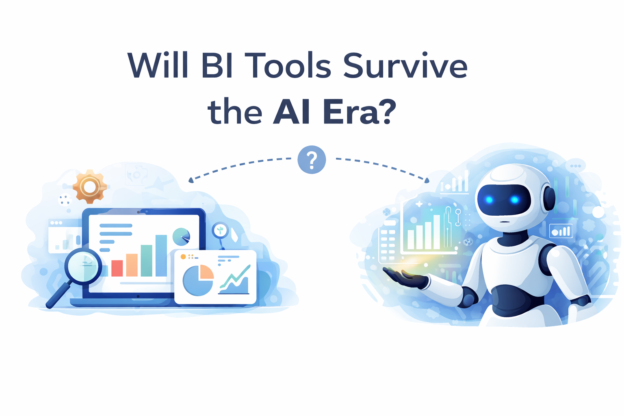
Over the past two years, artificial intelligence has rapidly entered the world of data and analytics. Large language models can now write SQL, explain trends, generate dashboards, and summarize reports in seconds. Because of this, a common question is starting to appear in data teams and executive meetings:
Some people believe that dashboards will soon disappear. Instead of opening a BI platform, they imagine asking an AI assistant questions like:
- “Why did revenue drop last week?”
- “What’s the conversion trend by channel?”
- “Which customer segments are declining?”
The assistant would instantly query the data warehouse, run analysis, and provide insights.
At first glance, this seems like the end of traditional Business Intelligence tools such as dashboards and reporting platforms.
But the reality is more complicated.
AI will certainly change how people interact with data. However, BI tools are unlikely to disappear. In fact, in many ways they may become more important, not less.
To understand why, we need to look at what BI tools actually do inside organizations—and how AI changes the analytics stack.
The Role BI Tools Play in Modern Organizations
Before discussing the future, it helps to clarify what BI tools really provide.
Many people think BI tools are simply chart generators. But in mature organizations, they play a much deeper role.
BI systems typically provide four key functions:
1. Metric standardization
Organizations rely on BI platforms to define consistent metrics.
For example:
- Revenue
- Active users
- Conversion rate
- Retention rate
These metrics must be calculated the same way across teams. If marketing, product, and finance each calculate “revenue” differently, decision-making becomes chaotic.
BI tools help centralize and standardize metric definitions.
2. Data accessibility
BI platforms provide a structured interface for non-technical users to explore data.
Executives, product managers, marketing teams, and operations leaders may not know SQL. BI tools allow them to:
- filter data
- explore trends
- segment users
- visualize performance
Without these tools, access to data would remain limited to technical teams.
3. Organizational visibility
BI dashboards function as shared operational views of the business.
Leadership meetings often rely on dashboards that track:
- revenue performance
- product engagement
- operational metrics
- financial indicators
These dashboards provide a single source of truth for decision-making.
4. Governance and data trust
BI systems also enforce governance.
They often control:
- data permissions
- certified datasets
- approved metrics
- reporting standards
This governance layer is critical for maintaining trust in data.
Why AI Is Challenging the BI Model
While BI tools provide important functions, AI introduces new capabilities that change how people interact with data.
Three developments are particularly significant.
Natural language analytics
AI systems now allow users to ask questions directly in plain language.
Instead of writing SQL or navigating dashboards, a user can type:
“Show me revenue growth by region for the past six months.”
The system can interpret the request, generate the query, and produce a chart.
This drastically lowers the barrier to data exploration.
Automated analysis
AI can also summarize patterns automatically.
For example, instead of manually inspecting charts, AI might report:
- “Revenue declined primarily due to lower conversion rates in mobile traffic.”
- “Retention decreased among new users acquired through paid social channels.”
This capability shifts analytics from manual interpretation to automated explanation.
Faster query generation
AI-assisted SQL tools can generate complex queries quickly.
Tasks that once required experienced analysts—such as building multi-join queries or cohort analyses—can now be partially automated.
This reduces the dependency on traditional BI interfaces.
Why BI Tools Are Unlikely to Disappear
Despite these advances, several structural reasons explain why BI tools are unlikely to vanish.
1. Organizations need stable metrics
Executives and operators require consistent definitions.
If each AI query dynamically calculates metrics differently, organizations lose alignment.
For example:
- Revenue calculated by finance must match revenue shown in product dashboards.
- Retention definitions must remain consistent across reports.
BI systems enforce this stability through curated datasets and governed metrics.
AI alone does not provide this governance layer.
2. Decision-makers rely on persistent views
Dashboards serve as persistent monitoring systems.
For instance, leadership teams may track:
- daily revenue
- weekly active users
- marketing spend efficiency
- operational KPIs
These views must remain stable over time. They allow teams to detect trends, anomalies, and long-term changes.
AI-generated answers are useful for ad hoc questions, but organizations still need persistent monitoring tools.
3. AI systems still depend on structured data models
Behind every AI-generated insight is a structured data pipeline.
To function properly, AI systems rely on:
- clean event tracking
- reliable data warehouses
- consistent identifiers
- standardized tables
These elements are typically managed through BI and data modeling layers.
In other words, AI sits on top of the same data foundation BI tools depend on.
4. Governance becomes more important in the AI era
AI introduces new risks.
If users can freely query data through AI assistants, organizations must ensure that:
- sensitive data remains protected
- definitions remain consistent
- generated insights are reliable
BI platforms provide guardrails that help maintain control.
Without these guardrails, organizations risk spreading incorrect or inconsistent insights at scale.
How BI Tools Will Likely Evolve
Although BI tools will survive, they will not remain unchanged.
Several shifts are already happening.
Natural language interfaces inside BI tools
Many BI platforms are adding AI assistants that allow users to interact with dashboards conversationally.
For example:
- asking follow-up questions
- generating additional visualizations
- explaining anomalies
Instead of replacing dashboards, AI becomes an interaction layer on top of them.
Automated insight generation
Future BI systems will likely include automated monitoring features.
Instead of manually checking dashboards, the system may automatically detect and explain changes in key metrics.
For instance:
- sudden drops in conversion
- unexpected traffic spikes
- shifts in user behavior
This transforms BI tools from passive reporting platforms into proactive insight systems.
Integration with predictive models
Traditional BI focuses on historical analysis.
However, modern BI platforms are increasingly integrating predictive capabilities.
Examples include:
- forecasting revenue trends
- predicting churn
- estimating demand
This blurs the line between BI and data science.
The Emerging Analytics Stack: BI + AI
Rather than replacing BI, AI is likely to become a new layer in the analytics stack.
A simplified view might look like this:
Data layer
- data warehouses
- ETL pipelines
- event tracking
BI layer
- metric definitions
- dashboards
- reporting governance
AI layer
- natural language analytics
- automated insights
- predictive models
- decision support systems
In this model, BI provides the structured foundation, while AI provides flexible intelligence on top of it.
The Real Transformation: From Dashboards to Decision Systems
The most important shift in the AI era is not the disappearance of dashboards.
Instead, it is the emergence of decision systems.
Traditional BI answers questions like:
- What happened?
- Where did it happen?
- How big was the change?
AI systems move toward questions such as:
- What will happen next?
- What should we do about it?
- Can the system act automatically?
This evolution expands analytics from reporting to decision support.
But decision systems still depend on reliable data foundations.
What This Means for Data Teams
For analysts and data professionals, the AI era does not eliminate the need for BI expertise.
Instead, it changes how those skills are applied.
Key capabilities that remain critical include:
- defining reliable metrics
- maintaining data quality
- designing data models
- ensuring governance
- interpreting results within business context
These responsibilities become even more important as AI accelerates access to data.
Final Thoughts
AI is transforming how people interact with data, and BI tools will inevitably evolve.
Natural language queries, automated insights, and predictive models will become standard features across analytics platforms.
However, the core functions of BI—metric standardization, governance, and organizational visibility—remain essential.
Rather than disappearing, BI tools will likely become the structured backbone of AI-powered analytics systems.
The future of data work is not a competition between BI and AI.
It is a combination of both.
Organizations that build strong BI foundations will be best positioned to take advantage of AI-driven analytics.
Discover more from Daily BI Talks
Subscribe to get the latest posts sent to your email.