
Over the last few years, “AI transformation” has become a board-level conversation.
Executives ask:
- Are we still doing BI?
- Should dashboards be replaced by copilots?
- Do we need fewer analysts and more machine learning engineers?
Underneath the noise, a more important question exists:
What actually changes when an organization moves from BI to AI?
Because the shift is real.
But it is not what many people assume.
AI does not replace BI.
It extends it — and exposes its weaknesses.
This article breaks down:
- What BI systems fundamentally do
- What AI systems add
- What genuinely changes in the data stack
- What remains unchanged
- How roles and workflows evolve
- What organizations often misunderstand
1. The Foundation: What BI Really Is
Before we talk about AI, we need to be precise about BI.
Business Intelligence is not “dashboards.”
It is a structured system for answering:
- What happened?
- How is performance changing?
- Where are anomalies?
- Which segments differ?
A mature BI layer includes:
- Clear metric definitions
- Reproducible SQL logic
- Reliable data models
- Governance and version control
- Shared semantic understanding
BI creates visibility systems.
It ensures that when two stakeholders look at “revenue,” they mean the same thing.
That foundation is more important in the AI era — not less.
2. What AI Adds to the Stack
AI extends analytics into prediction and action.
Where BI focuses on historical aggregation, AI focuses on forward-looking inference.
AI systems typically perform one or more of the following:
- Predict future outcomes
- Optimize decisions
- Automate actions
- Generate content or responses
If BI answers:
What happened?
AI answers:
What will happen?
What should we do?
Can the system decide automatically?
That shift moves organizations from reporting to intervention.
3. What Actually Changes
Now we can isolate the real changes.
3.1 From Metrics to Features
In BI, metrics are built for humans.
In AI, features are built for models.
Example:
BI metric:
- 30-day active users
AI features:
- 7-day activity delta
- Engagement decay slope
- Activity-to-cohort baseline ratio
- Recency-weighted interaction score
Metrics summarize behavior.
Features encode behavior into machine-readable signals.
This introduces:
- Feature stores
- Versioning
- Reproducibility concerns
- Training vs inference consistency
The system complexity increases.
3.2 From Reporting Cycles to Continuous Learning
BI systems update periodically:
- Daily
- Weekly
- Monthly
AI systems update based on:
- Retraining cadence
- Data drift
- Performance degradation
- Feedback loops
Instead of static snapshots, AI introduces dynamic adaptation.
This requires:
- Model monitoring
- Drift detection
- Alerting systems
- Retraining pipelines
The data stack becomes operational.
3.3 From Human Interpretation to Automated Decisions
BI:
Human reads dashboard → human acts.
AI:
Model scores entity → system triggers action.
Examples:
- Fraud score triggers payment block.
- Churn score triggers retention campaign.
- Risk score triggers manual review.
- Recommendation model changes ranking.
The automation layer increases leverage — and risk.
Errors scale faster.
3.4 From Query-Based Analysis to Hybrid Workflows
AI changes how analysts work.
New workflows include:
- AI-generated SQL
- Natural language metric exploration
- Code copilots
- Automated anomaly detection
Speed increases.
But validation responsibility remains human.
The bottleneck shifts from query writing to judgment.
4. What Does NOT Change
Despite new tooling, several fundamentals remain constant.
4.1 Data Quality Remains the Constraint
AI models do not fix:
- Inconsistent logging
- Broken joins
- Missing historical data
- Identity fragmentation
- Metric ambiguity
In fact, AI amplifies data problems.
A broken dashboard misleads a few decisions.
A broken model can mislead thousands per hour.
The data layer becomes more critical, not less.
4.2 Business Objectives Still Define Success
AI optimizes defined objectives.
Humans still choose:
- What to optimize
- How to measure success
- What trade-offs are acceptable
- Where constraints exist
If the objective is flawed, the model optimizes the wrong thing.
AI increases execution speed.
It does not replace strategic clarity.
4.3 Causality Still Matters
Prediction does not equal causation.
A churn model may predict who will leave.
It does not guarantee that intervention reduces churn.
AI systems often blur this distinction.
Without experimental discipline and causal thinking, automated systems risk optimizing noise.
4.4 Governance and Trust Become More Important
In BI:
Metrics need consistency.
In AI:
Decisions need accountability.
Organizations must answer:
- Why did this user get flagged?
- Why was this loan rejected?
- Why did this price change?
Explainability and auditability become structural requirements.
5. Organizational Shifts
The transition from BI to AI changes team structure and responsibilities.
5.1 Data Teams Become Cross-Functional
AI systems require coordination between:
- Analysts
- Data engineers
- Machine learning engineers
- Product managers
- Domain experts
The work moves from reporting pipelines to decision pipelines.
5.2 Analysts Evolve, Not Disappear
AI does not eliminate analysts.
Instead, their focus shifts toward:
- Feature engineering
- Experiment design
- Model validation
- Drift monitoring
- Guardrail metric definition
Strong SQL and metric discipline become foundational skills for AI workflows.
5.3 Decision Latency Decreases
In BI:
Decisions may take days or weeks.
In AI:
Decisions occur in milliseconds.
This changes risk tolerance, system design, and governance needs.
6. Common Misconceptions About the BI-to-AI Shift
Misconception 1: AI Replaces Dashboards
Dashboards remain essential for:
- Financial reporting
- Executive oversight
- Compliance
- Operational transparency
AI may summarize dashboards — but cannot replace governance structures.
Misconception 2: AI Eliminates the Need for Structured Data Models
In reality:
AI systems depend heavily on:
- Clean event schemas
- Stable identifiers
- Time-aligned datasets
- Reproducible transformations
The structured BI foundation becomes even more critical.
Misconception 3: AI Automatically Creates Value
AI increases leverage.
But value only emerges when:
- Objectives are well-defined
- Data is reliable
- Systems are monitored
- Trade-offs are understood
Otherwise, AI simply scales inefficiency.
7. A Better Mental Model
Instead of thinking:
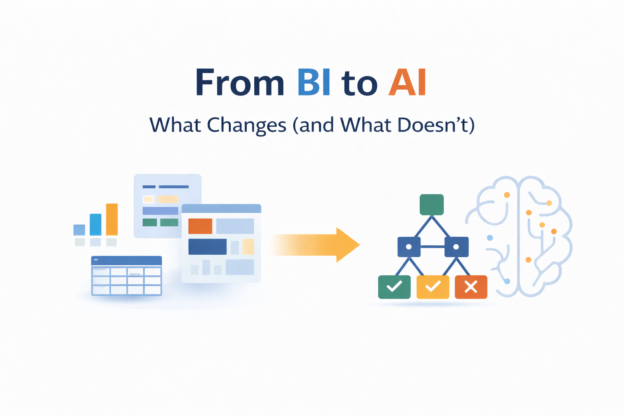
BI → AI (replacement)
Think:
BI (visibility layer)
+
AI (decision layer)
BI ensures clarity.
AI enables action.
Without clarity, action is dangerous.
Without action, clarity is limited.
The strongest organizations treat AI as an extension of a mature BI ecosystem.
8. Strategic Implications
Organizations preparing for AI should prioritize:
- Metric consistency
- Clean event tracking
- Identity resolution
- Feature reproducibility
- Experiment infrastructure
- Monitoring frameworks
AI is not a shortcut around foundational data discipline.
It is a multiplier.
Final Thoughts
The shift from BI to AI is not a revolution that wipes out existing systems.
It is a structural expansion.
What changes:
- Prediction becomes central.
- Automation increases.
- Model monitoring becomes operational.
What remains constant:
- Data quality defines reliability.
- Business objectives define success.
- Causal thinking defines impact.
- Governance defines sustainability.
The future is not “AI replacing BI.”
It is BI evolving into the backbone of AI-driven decision systems.
Organizations that understand this distinction build systems that scale responsibly.
Those that skip the foundation build fragile automation.
Discover more from Daily BI Talks
Subscribe to get the latest posts sent to your email.