
Over the past two years, Generative AI has dominated headlines.
ChatGPT can write emails.
Claude can summarize documents.
LLMs can answer questions, generate code, and even perform research.
With all this excitement, it’s easy to assume that traditional machine learning models are becoming obsolete.
After all, if a Large Language Model can reason, summarize, and converse, why would companies still rely on logistic regression models built twenty years ago?
Yet behind the scenes, most business-critical decisions are still powered by structured models.
When your bank evaluates a loan application, when an e-commerce company predicts churn, or when a logistics company estimates delivery risk, chances are a traditional machine learning model is doing the heavy lifting—not an LLM.
Understanding why requires understanding that these two technologies solve fundamentally different problems.
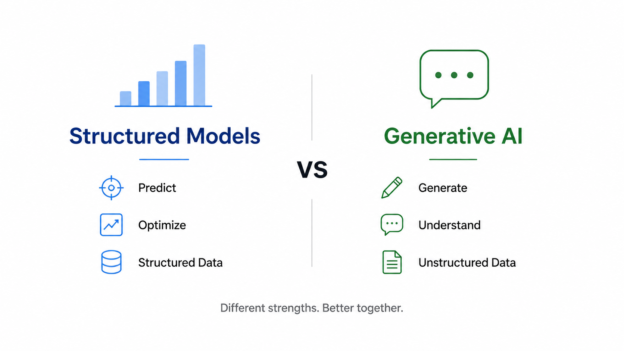
The Two Families of AI Systems
Before comparing them, let’s define them.
Structured Models
Structured models learn patterns from organized, tabular data.
Typical inputs look like:
| Customer ID | Orders Last 30 Days | Average Order Value | Days Since Last Purchase |
|---|---|---|---|
| 1001 | 5 | $42 | 7 |
| 1002 | 0 | $0 | 90 |
Examples include:
- Logistic Regression
- Decision Trees
- Random Forests
- XGBoost
- LightGBM
- CatBoost
These models answer questions such as:
- Will this customer churn?
- Is this transaction fraudulent?
- How much inventory should we stock?
- What is the probability of late delivery?
Generative AI
Generative AI works primarily with unstructured data.
Examples:
- Text
- Documents
- Images
- Audio
- Conversations
Inputs look more like:
“My package shows delivered, but I never received it. What should I do?”
or
“Summarize the following support ticket.”
Instead of predicting a score, Generative AI generates content.
Outputs might include:
- Answers
- Summaries
- Recommendations
- Drafts
- Code
This distinction matters enormously.
Why Structured Models Still Dominate Business Decisions
Let’s look at some real business systems.
Use Case 1: Customer Churn Prediction
Suppose Netflix wants to predict which subscribers are likely to cancel.
The available data:
watch_hours_30d
days_since_last_watch
subscription_age
number_of_profiles
support_tickets
This is highly structured.
A gradient boosting model can quickly learn:
- users inactive for 21+ days are high risk
- recent support issues increase churn
- subscription age affects behavior
The output:
Customer A: 12% churn risk
Customer B: 84% churn risk
This is exactly what the business needs.
Would an LLM perform better?
Probably not.
The data is already structured.
The task is prediction.
Structured models excel here.
Use Case 2: Fraud Detection
Credit card fraud systems process:
Transaction Amount
Merchant Type
Time of Day
Country
Historical Spending
Device Information
Millions of records arrive every hour.
The system must respond in milliseconds.
A tuned XGBoost model can score transactions extremely fast.
Generative AI cannot realistically replace this workflow today.
Why?
Because the task is:
Predict a probability from structured signals.
Not generate language.
Use Case 3: Demand Forecasting
A retailer wants to forecast:
- sales next week
- inventory needs
- warehouse staffing
Inputs:
Historical Sales
Promotions
Seasonality
Inventory Levels
Again:
- structured
- numerical
- time-dependent
Traditional forecasting models remain the preferred solution.
Where Generative AI Excels
Now let’s look at the opposite side.
Use Case 4: Customer Support
A customer submits:
“I ordered a laptop three weeks ago. The tracking page says delivered, but I never got it.”
The challenge is not prediction.
The challenge is understanding language.
Generative AI can:
- understand intent
- retrieve policies
- generate responses
- personalize communication
This is exactly what LLMs were built for.
Use Case 5: Internal Knowledge Search
Imagine an employee asking:
“What’s our reimbursement policy for conference travel?”
The answer exists inside:
- PDFs
- Wikis
- Internal documents
Structured models cannot easily solve this.
Generative AI combined with retrieval systems can.
Use Case 6: Document Processing
Insurance claims often contain:
- forms
- notes
- emails
- scanned documents
Generative AI can:
- extract information
- summarize claims
- classify documents
This dramatically reduces manual work.
The Real Future: Hybrid Systems
The biggest misconception is that organizations must choose one or the other.
In reality:
The most valuable systems combine both.
Example: E-Commerce Risk Review
Customer submits a return request.
Generative AI:
- reads the claim
- extracts relevant details
- summarizes the situation
Structured Model:
- evaluates fraud probability
- calculates financial risk
- predicts abuse likelihood
Decision Engine:
- approve
- reject
- send for review
Neither system alone is sufficient.
Together they create a much stronger workflow.
Example: Logistics Claims Processing
Imagine a logistics company handling “Delivered but Not Received” claims.
The customer writes:
“FedEx marked my package delivered yesterday, but I checked my front door and neighbors and can’t find it.”
Generative AI can:
- classify the issue
- extract key facts
- summarize customer context
Structured Models can evaluate:
Delivery Scan History
Carrier
ZIP Code
Historical DNR Rate
Package Value
Weather Conditions
The model predicts:
Likelihood of Valid Claim: 87%
The company combines both outputs to make a decision.
Cost Matters More Than Most People Realize
Another reason structured models survive:
They’re cheap.
A logistic regression model can process millions of predictions for a fraction of the cost of running an LLM.
For large-scale business systems:
- ad ranking
- recommendations
- fraud detection
- risk scoring
Cost becomes a major consideration.
Many companies are discovering:
Just because an LLM can do something doesn’t mean it should.
Explainability Matters Too
Executives often need answers.
For example:
Why was this loan rejected?
A logistic regression model can explain:
Debt-to-income ratio contributed 35%
Credit utilization contributed 28%
Recent delinquency contributed 17%
Generative AI systems are often less transparent.
In regulated industries:
- banking
- healthcare
- insurance
Explainability remains critical.
A Practical Decision Framework
When evaluating a business problem, ask:
Is the data mostly structured?
Examples:
- transactions
- metrics
- user behavior
→ Use structured models first.
Is the data mostly unstructured?
Examples:
- documents
- emails
- support tickets
- conversations
→ Generative AI is often the better fit.
Do you need prediction?
Examples:
- churn
- fraud
- risk
→ Structured models.
Do you need understanding or generation?
Examples:
- search
- summarization
- assistance
→ Generative AI.
The Biggest Opportunity Isn’t Replacement
Many organizations are asking:
“How do we replace traditional models with AI?”
The better question is:
“How do we combine structured models and Generative AI to create better business systems?”
That’s where most of the next decade’s value will come from.
Not from replacing one with the other.
But from using each technology where it performs best.
Final Thoughts
Generative AI is transforming how businesses interact with information.
But it is not replacing structured models anytime soon.
Structured models remain unmatched for:
- prediction
- risk scoring
- forecasting
- optimization
- large-scale decision systems
Generative AI excels at:
- understanding language
- generating content
- searching knowledge
- assisting users
The most successful business systems will combine both.
Because the future is not:
Structured Models vs Generative AI
It’s:
Structured Models + Generative AI
And understanding where each belongs is becoming one of the most important skills in modern data science.
Discover more from Daily BI Talks
Subscribe to get the latest posts sent to your email.