
If you’ve worked in BI or analytics long enough, you’ve probably heard people talk about models as if they were something mysterious.
“Once we build a model, we can predict this.”
“The model says this user will churn.”
“We need a better model for this problem.”
For many analysts, data science models feel abstract and intimidating, especially if you don’t come from a math or computer science background.
This article is here to change that.
By the end of this guide, you’ll understand:
- What a data science model actually is (in plain English)
- How models relate to problems you already solve as an analyst
- The main types of data science models used in practice
- Why models are not magic—and why that’s a good thing
What Is a Data Science Model?
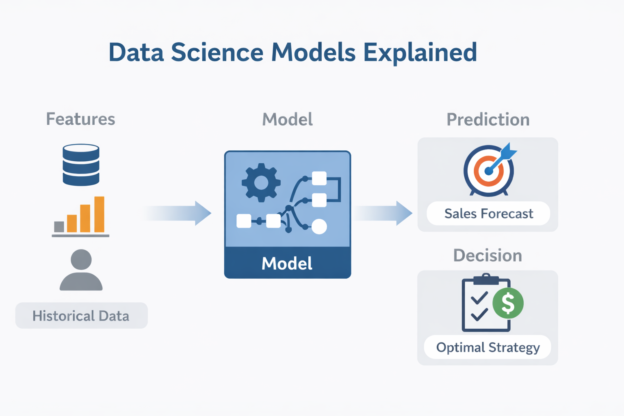
At its core, a data science model is a structured way to use historical data to make decisions about the future.
More specifically:
A data science model learns patterns from past data to predict, classify, or optimize outcomes you care about.
That’s it. No magic. No buzzwords.
If you’ve ever:
- Estimated next month’s demand
- Segmented users by behavior
- Compared scenarios to choose the cheapest option
You were already thinking like a data scientist—just without calling it a model.
How Models Are Different From BI Reports
Business intelligence focuses on describing what has already happened.
Data science focuses on anticipating what will happen next—or what you should do.
| BI | Data Science |
|---|---|
| What happened? | What will happen? |
| Dashboards & metrics | Predictions & decisions |
| Historical summaries | Forward-looking insights |
This doesn’t mean data science replaces BI.
In practice, data science builds on top of BI.
If your data is wrong, your model will be wrong—just faster and more confidently.
What Does a Data Science Model Actually Learn?
A common misconception is that models “discover insights” on their own.
What models really learn is much simpler.
They learn the relationship between inputs and an outcome.
In data science terms:
- Features → the inputs (what you know)
- Target → the outcome (what you want to predict)
If you’re coming from BI, this should feel familiar.
| BI Concept | Data Science Term |
|---|---|
| Columns / fields | Features |
| KPI / metric | Target |
| Grouping logic | Model structure |
| Business rules | Learned patterns |
A model doesn’t invent new information.
It formalizes relationships that already exist in your data.
The Three Core Types of Data Science Models
Most real-world data science work falls into just three categories.
1. Regression Models: Predicting Numbers
Regression models answer questions like:
- How many units will we sell?
- What will this shipment cost?
- How long will this process take?
If the output is a number, it’s usually a regression problem.
One important clarification:
Regression is not the same as time series forecasting.
Time is just one possible feature. Regression models can predict numerical outcomes using many types of inputs, not just dates.
2. Classification Models: Predicting Categories
Classification models answer questions like:
- Will this user churn?
- Is this transaction fraudulent?
- Will this order be delayed?
The output is a category, often binary (yes / no), but sometimes multi-class.
A useful mental shift for analysts:
Many problems that feel like prediction problems are actually classification problems.
This distinction matters because it affects:
- How models are evaluated
- How results are interpreted
- How decisions are made
3. Optimization Models: Choosing the Best Action
This is the most overlooked category—and one of the most valuable.
Optimization models answer questions like:
- Which option minimizes cost?
- How should we allocate limited resources?
- Which vendor should we choose?
Unlike regression or classification, optimization is about decision-making, not prediction.
In many businesses, prediction is only a step toward optimization.
Models Don’t Replace Judgment—They Support It
A common fear among analysts is that models “replace human thinking.”
In reality, models are only as good as:
- The problem definition
- The data used
- The assumptions made
A well-built model doesn’t tell you what to think.
It helps you think more consistently and at scale.
Good data scientists spend more time:
- Defining the right question
- Choosing the right target
- Evaluating trade-offs
Than tuning algorithms.
Why Analysts Are Well-Positioned to Learn Data Science Models
If you already work with data, you have a head start.
Analysts tend to be strong at:
- Understanding business context
- Spotting data quality issues
- Translating vague questions into measurable metrics
These skills matter more than advanced math in most applied data science roles.
Learning data science models is less about becoming a machine learning expert and more about expanding your analytical toolkit.
Final Thoughts
A data science model is not an abstract academic concept.
It’s a practical tool for answering questions that businesses care about:
- What will happen?
- What should we do?
- What is the trade-off?
Once you stop thinking of models as mysterious black boxes, they become what they really are:
structured, repeatable ways to reason with data.
If you’re an analyst curious about data science, this is a great place to start.
Discover more from Daily BI Talks
Subscribe to get the latest posts sent to your email.